Neuroendocrine Prostate Cancer (NEPC)
Neuroendocrine prostate cancer (NEPC) is an aggressive subtype of prostate cancer associated with treatment resistance and poor clinical outcomes.
In addition to tumors that exhibit neuroendocrine features at initial diagnosis, treatment-emergent NEPC (t-NEPC) can develop during the course of treatment for advanced prostate cancer, particularly following androgen receptor (AR)-targeted therapies.
Our research focuses on lineage plasticity, through which prostate cancer cells alter their cellular identity during the acquisition of treatment resistance, as well as on the tumor microenvironment that may promote and sustain this transition.
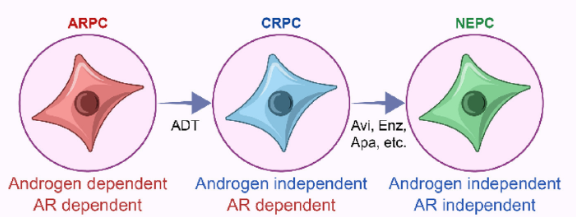
Watanabe R, Haffner M, Nelson P et al. Urol. Oncol. 2026
How does prostate cancer evolve into NEPC?
We compare prostate adenocarcinoma before treatment with NEPC that emerges after therapy in the same patients and perform high-resolution spatial transcriptomic analyses.
By analyzing not only tumor cells but also surrounding stromal and immune cells, we aim to characterize changes in gene expression and tumor–microenvironment interactions associated with the transition to NEPC.
In particular, we investigate SASP, inflammation, TGF-β, NF-κB, and interferon signaling to understand the microenvironmental factors that may contribute to treatment resistance and neuroendocrine differentiation.
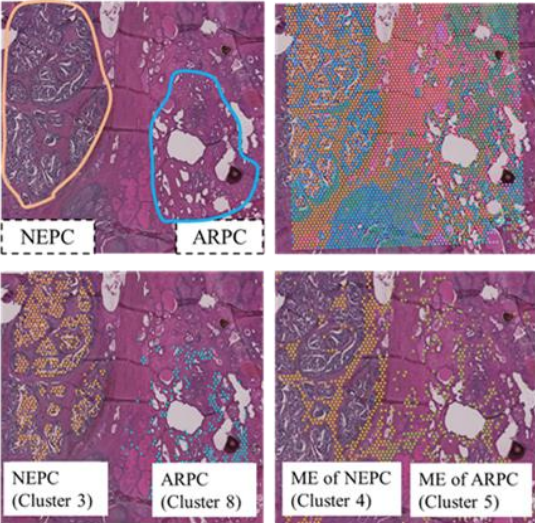
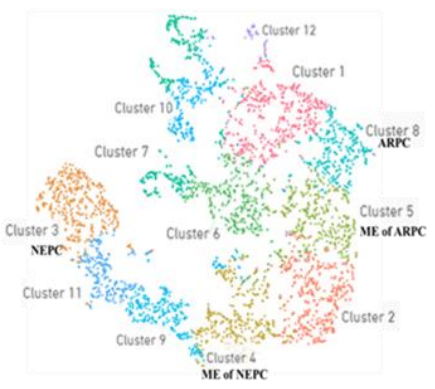
Watanabe et al. Int J Mol Sci 2023
Molecular Characterization of NEPC through a Nationwide Cohort
NEPC is a rare disease, making it difficult for any single institution to collect and analyze a sufficiently large number of cases.
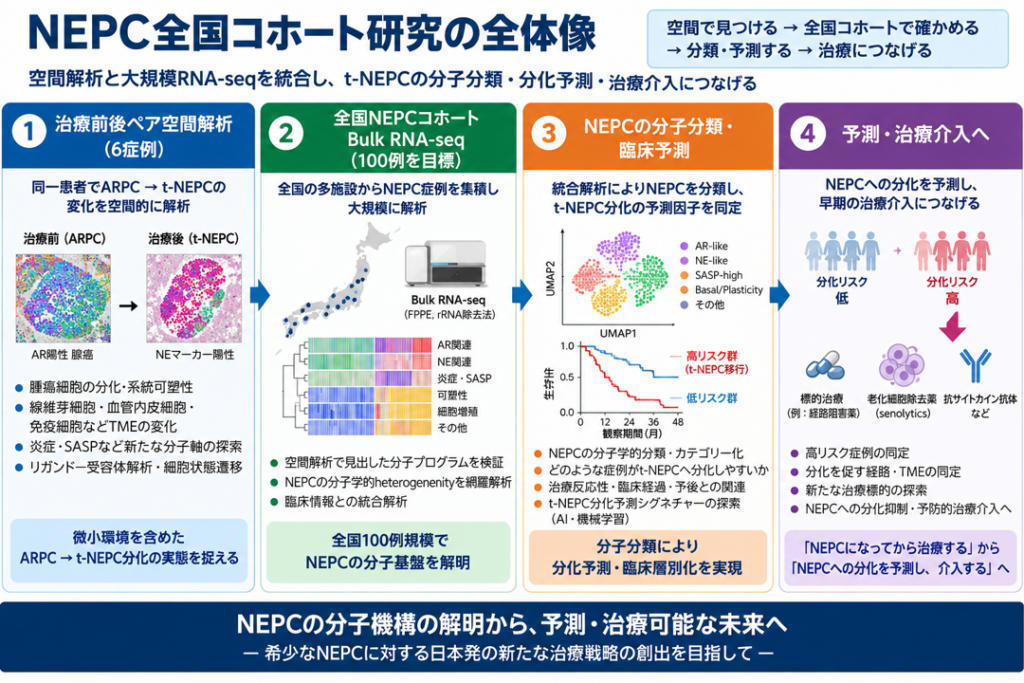
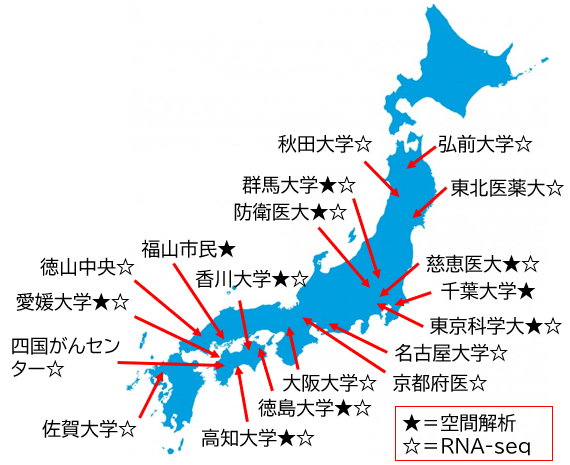
To address this challenge, we have established a nationwide multicenter cohort of NEPC in collaboration with institutions across Japan and are conducting RNA sequencing and spatial transcriptomic analyses.
By characterizing the transition to NEPC at spatial resolution and validating these findings in the nationwide cohort, we aim to establish a molecular classification of NEPC, identify predictors of NEPC development, and discover novel therapeutic targets.
Toward Prediction and Treatment of NEPC
Our ultimate goal is not simply to diagnose NEPC after it has developed, but to predict which prostate cancers are likely to progress to NEPC and intervene early in this process.
We validate findings from patient-derived specimens using experimental models, including patient-derived xenografts (PDXs) and organoids, with the goal of translating these discoveries into new diagnostic and therapeutic strategies.
Related Publications
Enzalutamide promotes an early plasticity-associated transcriptional state without terminal neuroendocrine differentiation in prostate cancer cells
Watanabe R, Chosei M, Arai H, Miura N, Kikugawa T, Saika T.
Front Oncol. 2026;16:1870253.
PMID: 42568401
Cellular plasticity and tumor ecosystem dynamics in prostate cancer: insights from single-cell and spatial transcriptomics
Watanabe R, Chu T, Miura N, Kikugawa T, Nelson PS, Saika T.
Am J Clin Exp Urol. 2026;14(3):64-85.
PMID: 42488354
Molecular pathology of rare histologic variants and treatment-resistant lineages of prostate cancer
Watanabe R, Miura N, Kikugawa T, Saika T, Haffner MC, Nelson PS.
Urol Oncol. 2026;44(4):110987.
PMID: 41605126
Paired-sample Analysis of ERG Expression and TMPRSS2-ERG Fusion in Treatment-induced Neuroendocrine Prostate Cancer
Watanabe R, Shigehisa R, Kawada T, Yamamoto S, Katayama S, Takamoto A, Nishimura K, Miura N, Araki M, Inoue K, Saika T; Chu-shikoku Japan Urological Consortium (CsJUC) Research Collaboration.
Anticancer Res. 2026;46(4):1929-1942.
PMID: 41895744
Spatial Gene Expression Analysis Reveals Characteristic Gene Expression Patterns of De Novo Neuroendocrine Prostate Cancer Coexisting with Androgen Receptor Pathway Prostate Cancer
Watanabe R, Miura N, Kurata M, Kitazawa R, Kikugawa T, Saika T.
Int J Mol Sci. 2023;24(10):8955.
PMID: 37240308