Metastatic Hormone-Naïve Prostate Cancer (mHNPC)
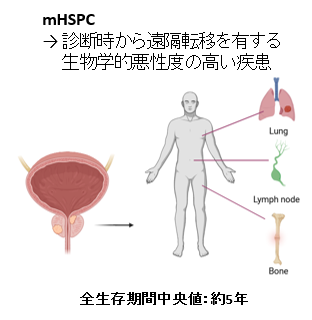
Metastatic hormone-naïve prostate cancer (mHNPC) is prostate cancer that has spread to distant sites but remains sensitive to androgen deprivation therapy.
In recent years, treatment outcomes have improved through the early use of intensified hormonal therapy and chemotherapy. However, even among patients with mHNPC, treatment responses and subsequent clinical courses vary substantially.
Our research focuses on tumor heterogeneity that is already present before treatment begins.。
Distinct Cellular States Coexist within a Single Tumor
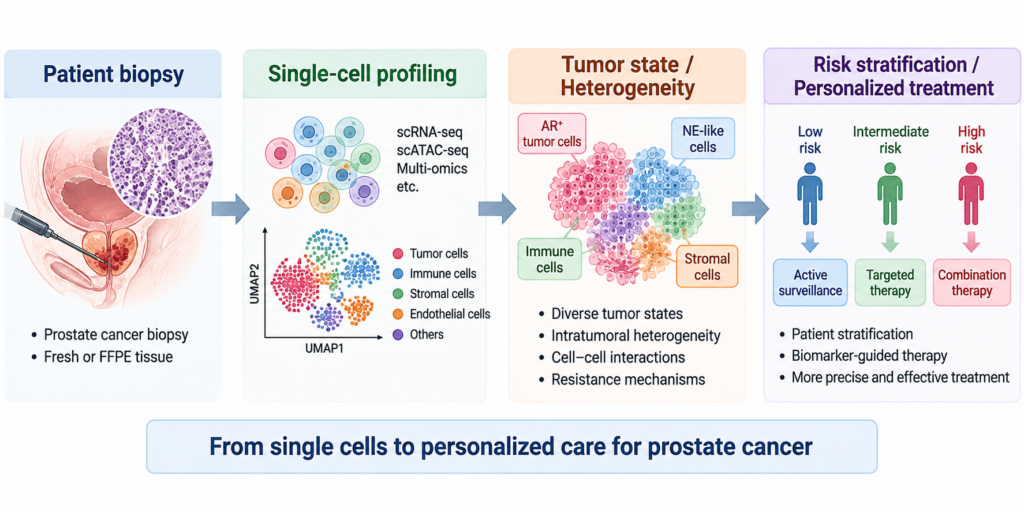
We perform single-cell RNA sequencing of treatment-naïve mHNPC specimens to characterize the cellular composition of individual tumors at single-cell resolution.
Our analyses reveal that, even before treatment, tumors contain not only conventional Luminal/AR-positive cancer cells but also distinct epithelial populations with Basal/Stem-like and EMT/stromal-like features.

Pre-existing “Seeds of Resistance” before Treatment
Tumors with basal-associated features show increased activity of stem-like, EMT, TGF-β, and p53-related programs, which are associated with treatment resistance and tumor progression.
In contrast, we did not identify a distinct neuroendocrine tumor-cell population in the treatment-naïve mHNPC specimens analyzed.
These findings suggest that prostate cancer may not become heterogeneous only after exposure to therapy. Instead, cellular states with the potential to contribute to future treatment resistance may already exist before treatment begins.

Looking Beyond Tumor Burden to “Tumor Biology”
Current treatment strategies for mHNPC are largely guided by clinical factors such as metastatic burden and risk classification. However, even among patients with similar clinical features, the cellular states that constitute their tumors may differ substantially.
Using single-cell approaches, we aim to characterize biological aggressiveness and potential treatment resistance before therapy begins and to develop biomarkers that can guide more individualized treatment selection for each patient.
Related Publications
Single-Cell Analysis Reveals Pre-Existing Basal-Associated Epithelial States in Metastatic Hormone-Naïve Prostate Cancer
Watanabe R, Chosei M, Sakaue T, Miura N, Kikugawa T, Saika T.
Int J Mol Sci. 2026 Jun 16;27(12):5405.
PMID: 42353123
Enzalutamide promotes an early plasticity-associated transcriptional state without terminal neuroendocrine differentiation in prostate cancer cells
Watanabe R, Chosei M, Arai H, Miura N, Kikugawa T, Saika T.
Front Oncol. 2026 Jul 24;16:1870253.
PMID: 42568401
Cellular plasticity and tumor ecosystem dynamics in prostate cancer: insights from single-cell and spatial transcriptomics
Watanabe R, Chu T, Miura N, Kikugawa T, Nelson PS, Saika T.
Am J Clin Exp Urol. 2026 Jun 15;14(3):64-85.
PMID: 42488354